About the client
British Airways is the United Kingdom's flag carrier, operating one of the world's most complex hub operations from London Heathrow. The airline flies to 200+ destinations, operating more than 1,850 scheduled departures a week from Heathrow alone. Hundreds of aircraft movements a day require coordinated ground resources, crew and stands.
"Mission Control allows us to reduce any inconveniences to our customers and ensure that we're able to turn the operation as quickly as possible."
Richard Anderson, Director of Global Operations, British Airways
Value proposition
British Airways is strengthening the resilience of its Heathrow airside operation with Flo.w
Background
British Airways operates one of the world's most complex turn operations, with hundreds of daily aircraft movements across multiple terminals. Coordinating ground resources, crew and stands demands constant, real-time reorchestration. Historically, BA's operations team relied on reactive delay management, responding to disruption after it had already begun to compound. The airline needed total situational awareness and decision support that would let controllers anticipate resource conflicts, model interventions ahead of time, and act before a local issue became a wider disruption.
Approach
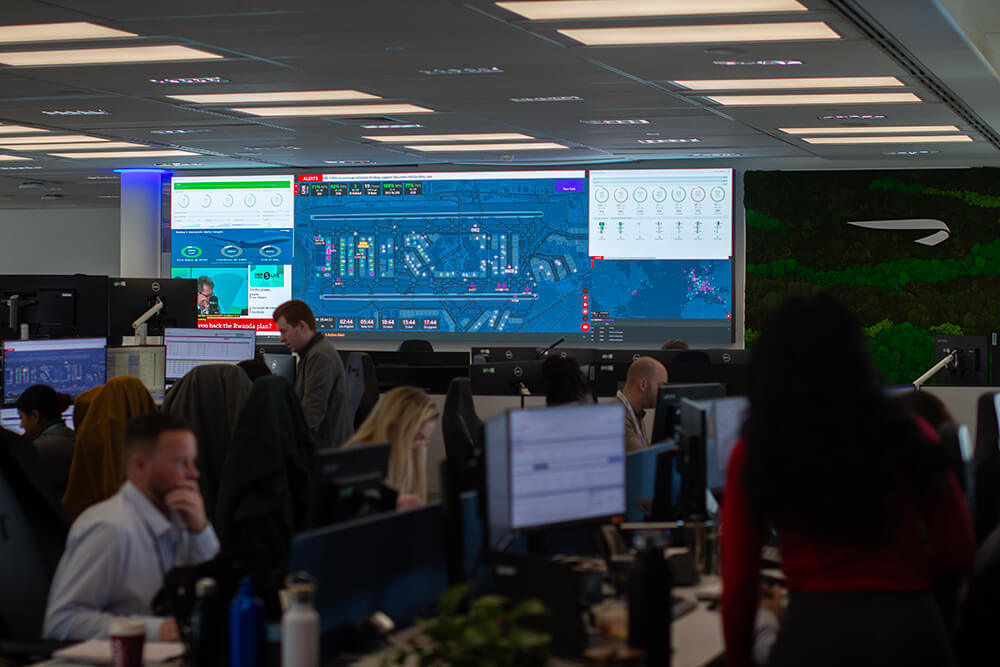
British Airways deployed Flo.w into its Integrated Operations Centre at Heathrow, where it operates internally as Mission Control. Flo.w consolidates real-time aircraft movement data with BA's AODB, ADS-B feeds, ground vehicle telematics and crew systems into a single operational view, giving controllers the situational awareness that was previously concentrated in a small number of experienced staff.
This has moved BA's Integrated Operations Centre from reacting to delay after it happens to identifying resource conflicts and acting on them before they escalate. Mission Control has contributed to more than $20M in annual savings, through over 200,000 minutes of delay avoided across BA's hub and international operation. Below, we've broken down a portion of that value into four fully attributable, independently costed pathways: stand and turnaround optimisation, EU261 compensation avoidance, hub connection integrity, and ground movement efficiency.
Results breakdown
Flo.w surfaces real-time stand occupancy, departure readiness, and airside movement data in one view, giving dispatchers the intelligence to intervene before delays occur.
EU261 compensation for flights delayed over 3 hours ranges from $275–$660 per passenger. Flo.w's predictive alerts identify flights approaching the threshold in time to take action.
At-risk connections are identified in real time, giving ops the window to hold aircraft, fast-track passengers, or rebook proactively rather than reactively.
Real-time visibility of tug fleet positions and turnaround timelines allows dispatchers to optimise tow sequencing and cut idle time.
"The tech colleagues have at their fingertips has been a real gamechanger for performance."
Sean Doyle, CEO, British Airways