About the client
The UK Civil Aviation Authority (CAA) is the public body responsible for regulating and designing UK airspace, operating under the Department for Transport. The CAA needs a continuous, evidence-based understanding of how the UK's airspace structures are used today, and how proposed changes, from drone integration to spaceport activity, would affect them.
"The Airspace Analyser has proven invaluable to the Airspace Classification Review Team. The ability to filter and interrogate historical and live data allows us to investigate and validate insight that we receive through a variety of channels. This has helped to influence and shape our discussions with airspace change applicants and airspace users."
Principal Airspace Delivery, UK Civil Aviation Authority
Value proposition
Background
The UK Civil Aviation Authority is responsible for regulating and designing the UK's airspace, and needs a clear, evidence-based understanding of how that airspace is used today, and how proposed changes would affect it. Before Flo.w, this analysis relied on commissioning an external consultancy for each individual study, a process that was slow, manual, and expensive. By the time these long-winded reports were delivered, the underlying airspace picture had often already moved on, leaving CAA analysts working from a point-in-time view that was out of date before it was even finished.
As drone integration and spaceport activity placed growing demands on UK airspace, the CAA needed the ability to understand utilisation continuously, not periodically.
Approach
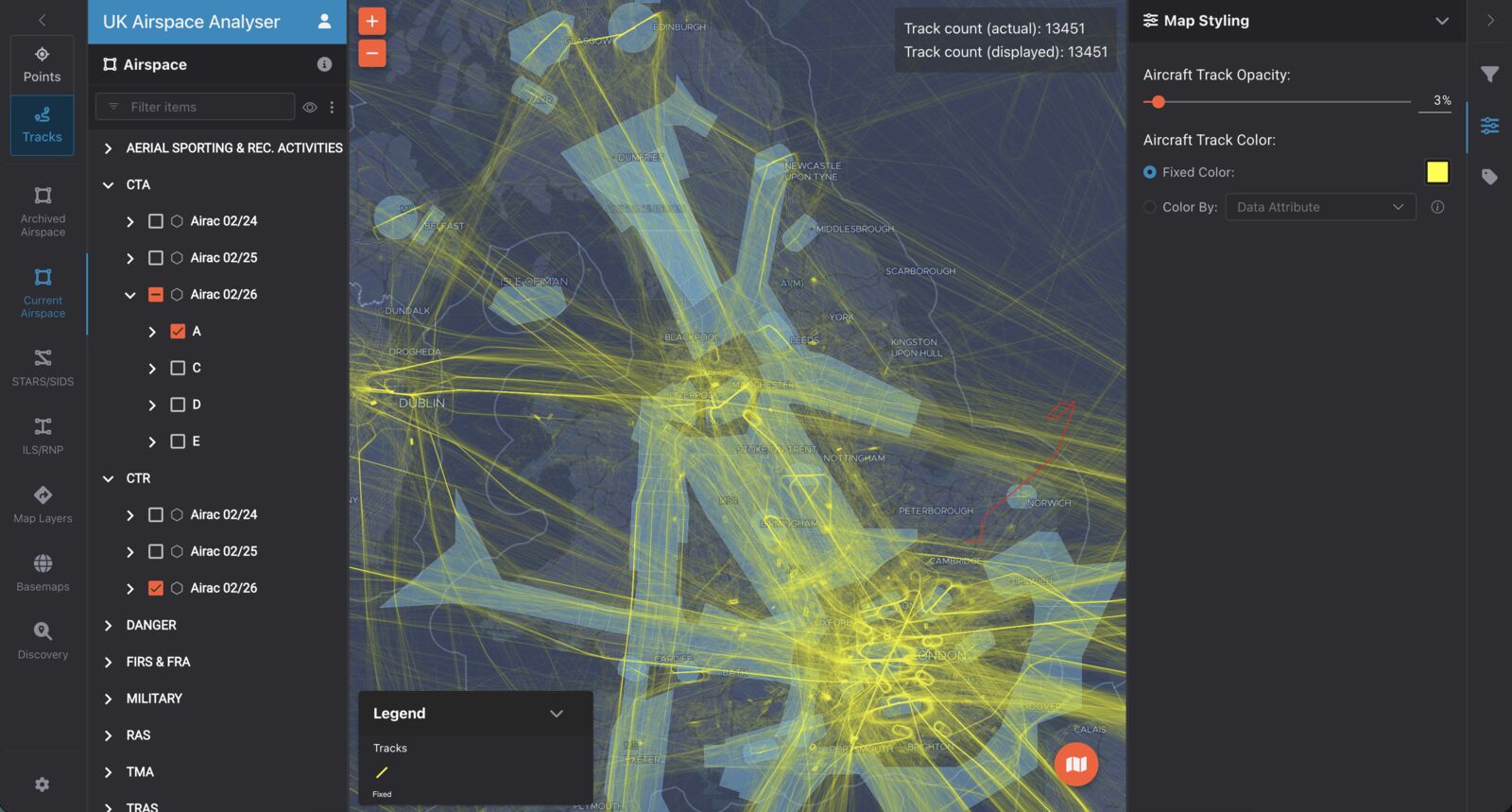
CAA worked with Emu Analytics to build Airspace Analyser (AA) on Flo.w. Airspace Analyser continuously ingests real-time aircraft location data, picked up by ground receivers from partner Plane Finder, processing thousands of ADS-B data points every second from aircraft transmitters. This is turned into a measure of how aircraft intersect each of the hundreds of 3D airspace structures across the UK.
This has moved the CAA from commissioning periodic, external analysis to running continuous, real-time airspace monitoring in-house. Analysts can now query patterns of airspace usage by geography, time period, aircraft type, and traffic density on demand, building evidence for regulatory investigations, consultations, and long-term airspace modernisation without waiting on an external report.
Results breakdown
"The additional overlaid safety data such as airprox and infringements, adds a significant layer of intelligence to help us generate effective and positive airspace change."
Principal Airspace Delivery, UK Civil Aviation Authority