About the client
London Gatwick is the UK's second-largest airport and the world's busiest single-runway airport, a high-throughput operation where aircraft, ground handlers, and service vehicles share a tight, constantly moving airside. Flo.w was deployed for Gatwick Airport's innovation team, running as a light-scale, low-cost pilot to prove out the business case for a full operational deployment.
Value proposition
Background
Gatwick's airside is one of the busiest operational environments in the UK, with aircraft, ground handlers, and service vehicles all moving through a tight, high-throughput space. Off-stand holds, delays, and inefficiencies often traced back to a simple problem: the teams making split-second decisions didn't have full visibility of what was happening around them. Different systems held different pieces of the picture, and operations teams were asked to make immediate calls without time to piece it all together.
That gap in visibility didn't stop at the airport's own boundary. The airport, the airline, and the ground handlers were all making decisions based on how their own assets were moving, without visibility of what the others were doing or how their decisions affected each other. Every partner was operating with incomplete information, and if one made the wrong call, the impact was felt across all of them. This is a challenge shared by nearly every airport where physical capacity, such as runways and stands, and human capacity, such as operations staff, are already stretched.
Approach
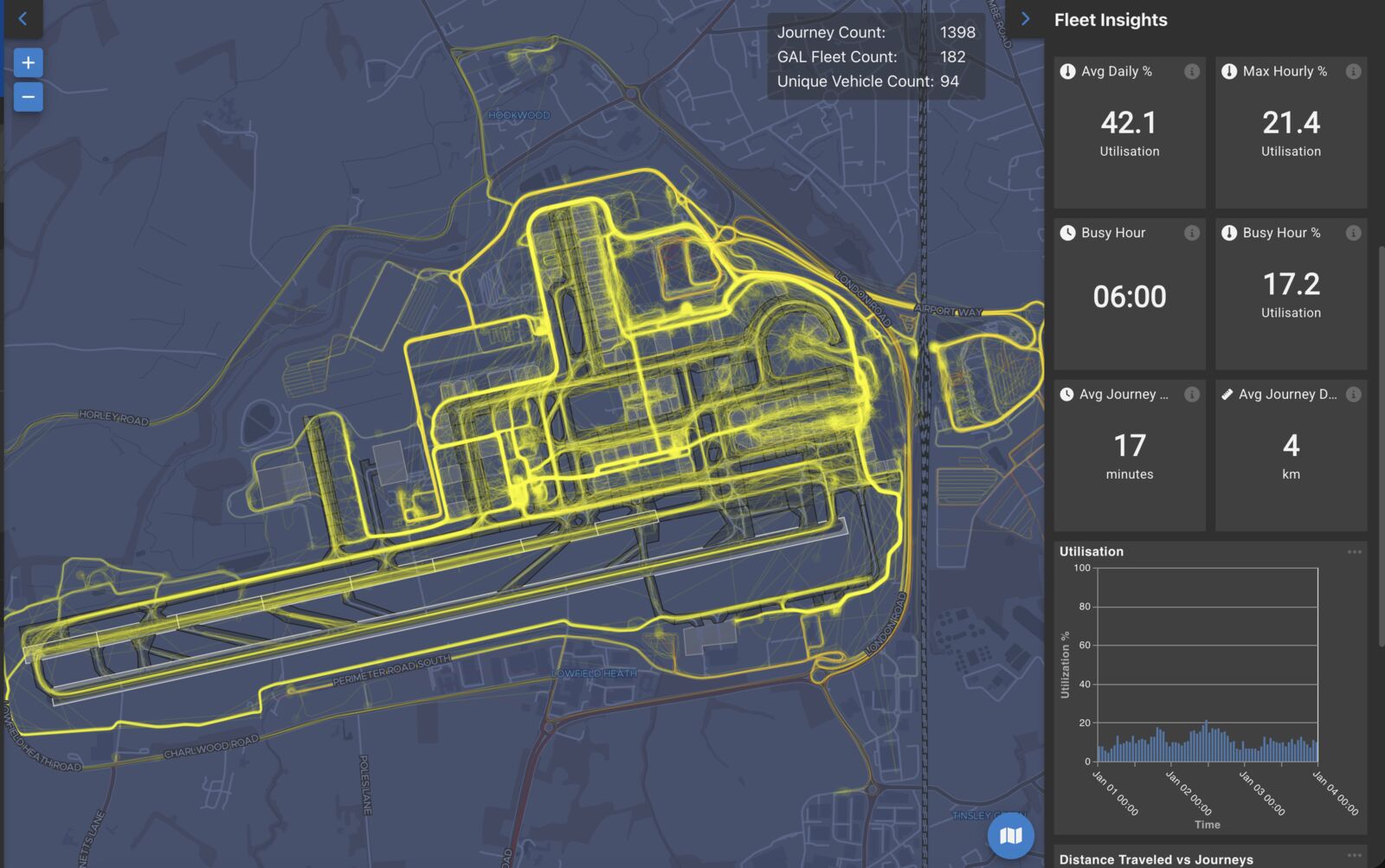
Gatwick Airport's innovation team deployed Flo.w as a pilot to demonstrate what a shared, real-time operational picture could deliver across an airport ecosystem. The pilot supported live situational awareness for airside operations with configurable alerts, vehicle fleet utilisation analysis, off-stand hold and taxiway dwell analysis, ASAT delay analysis, and stand and pier asset counts.
What made this deployment distinctive is that it wasn't confined to the airport alone. Gatwick, EasyJet, and ground handling partners including DHL all worked from the same real-time view, seeing the same alerts, the same hotspots, and the same movements as they happened. Instead of each organisation working from its own version of events, every partner could coordinate and respond together, getting more out of the runway, stand, and workforce capacity already available.
Results breakdown
Gatwick's pilot showed exactly where and why off-stand holds happened, aircraft landing and waiting because a stand wasn't ready or the path there wasn't clear. For the world's busiest single-runway airport, every minute of avoidable holding is a minute of runway capacity that could have gone to another movement.
The pilot's fleet utilisation analysis showed where ground vehicles were sitting idle. At a busy airport like Gatwick, where ground handlers, service vehicles, and aircraft all share the same tight space, idle vehicles limit how much the operation can move.
Gatwick's ASAT delay analysis automatically identified patterns in departure delay that had previously required manual, after-the-fact investigation. At a single-runway airport, where one bottleneck can ripple across the entire day's schedule, knowing the real cause of recurring delay is the difference between fixing the right problem and guessing at it.