About the client
Qantas is Australia's largest airline and one of the world's most recognised long-haul carriers, operating a combined fleet of 266 aircraft across mainline Qantas and its regional subsidiary QantasLink. From its primary hub at Sydney Kingsford Smith Airport, the group serves a vast domestic and international network where delays in one part of the operation cascade quickly across the whole.
Value proposition
Background
Recurring towing delays at Sydney were impacting gate availability, engineering schedules, and on-time performance across Qantas's network. The knock-on effects of a delayed tow rarely stayed local: late gate returns disrupted inbound aircraft, compressed turnaround windows, and placed engineering resources under pressure.
The prevailing internal assumption was that the delays were primarily caused by ATC runway crossing restrictions. Operational strategy had been shaped around this belief for years. Without data to confirm or challenge it, the assumption remained in place and the delays continued.
Approach
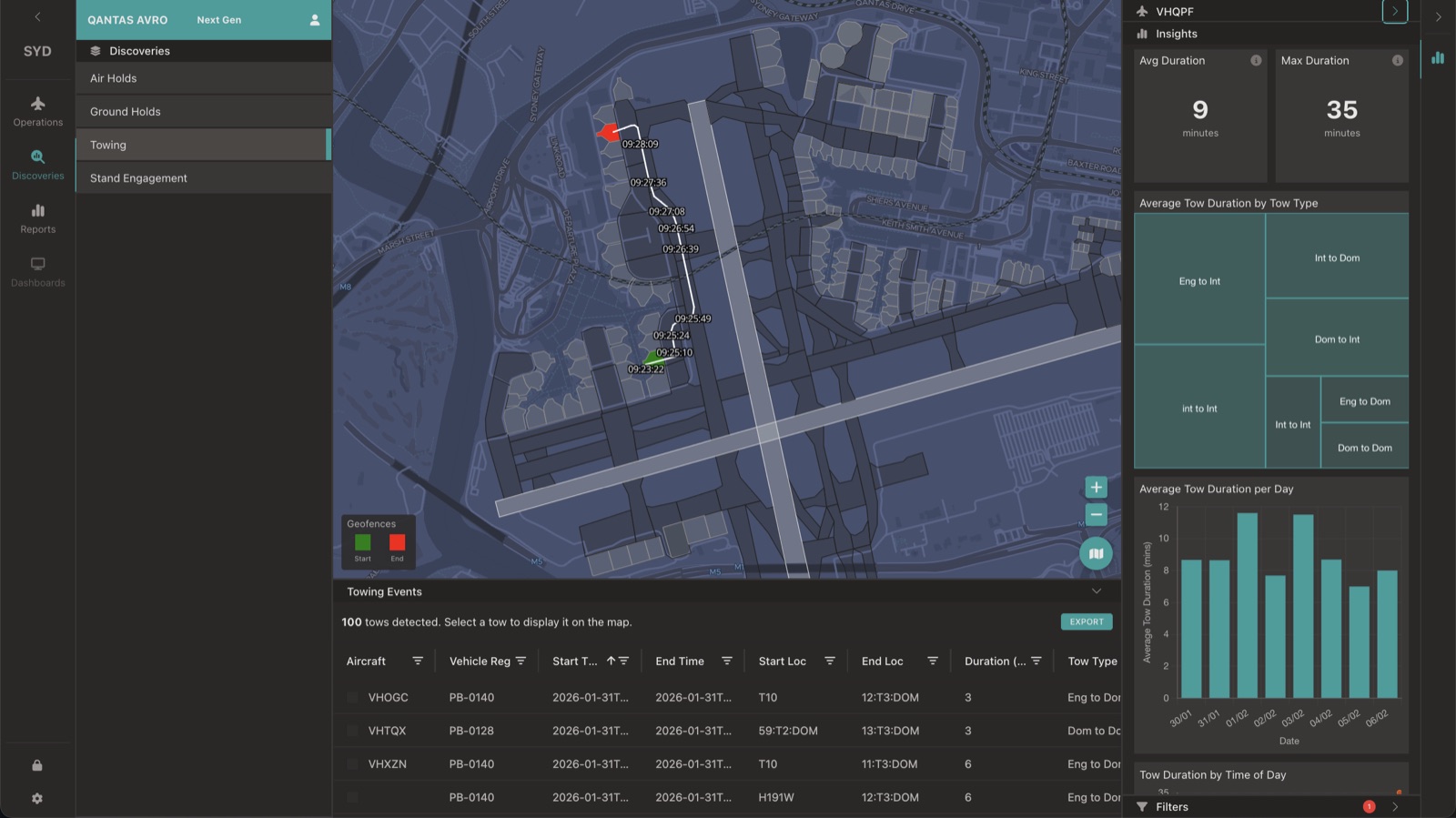
Flo.w was deployed to track all towing movements at Sydney in real time, building a complete picture of where tows paused, queued, and slowed across the airfield. Every movement was captured from the moment a tow began to the moment it completed.
Historical replay across thousands of tow events gave the operations team the ability to look back across patterns they had never previously been able to examine. The data told a different story from the prevailing assumption: ATC runway crossing restrictions were not the primary cause of the delays. The real constraints lay elsewhere in the operation.
With the assumption overturned and the actual causes identified, Qantas redesigned their towing strategies around the real operational constraints. Based on industry benchmarks and the Sydney tow volumes, the improvement potential is estimated at ~$1.8M annually.
Capabilities
For the first time, Qantas operations teams had a single real-time view of aircraft and ground fleet movements across their Sydney hub, replacing fragmented radio-based reporting with a complete, continuous picture.
Real-time awareness of towing progress, stand occupancy, and aircraft movement reduced the gate conflicts and schedule compressions that had been a persistent feature of peak operations.
Early detection of tow delays gave operations teams the chance to intervene before downstream impacts took hold, shifting the response from reactive recovery to proactive management.
Historical replay across 13,000+ annual tow events at Sydney made it possible to identify exactly where and why tows were delayed, providing the evidence base to redesign towing strategies around real operational constraints.
Book a 30-minute demo and we'll show you exactly what Flo.w looks like in your environment, with your data.